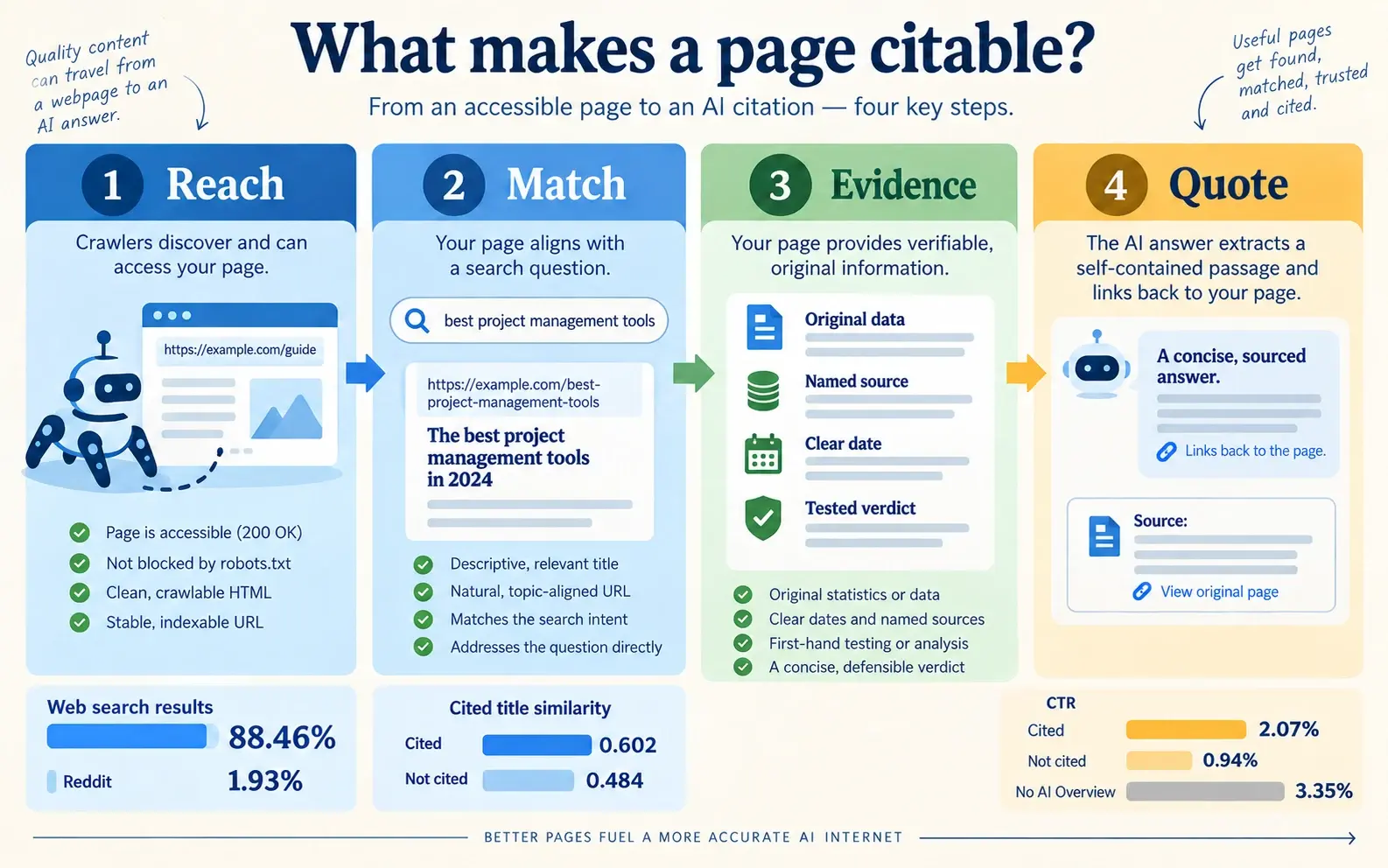
An AI assistant cites a page when three things line up. Its search step finds the page, the page's title and URL match the question in meaning, and the text gives it a specific answer to quote and link back to. Traditional SEO handles the first step. Relevance, evidence, authority and clear structure decide the rest. Ahrefs studied 1.4 million ChatGPT prompts, and the results show how much the second step matters. The click data says the work pays off: in Seer Interactive's 2025 data, brands cited in Google's AI Overviews earned about 120% more organic clicks per impression than brands that weren't.
Step one: get found by search
Assistants cite what their search step finds. In Ahrefs' study, URLs from ChatGPT's `search` channel were cited 88.46% of the time, and URLs from its separate `reddit` channel were cited 1.93% of the time. Overall, ChatGPT cited about half the URLs it retrieved. Google's AI features work on the same foundation: Google says a page only needs to be indexed and eligible to show a snippet, with no extra requirements.
Page one helps, but it isn't the whole story. One study looked at 55,393 trending queries across 19 topic categories, collected from 13 March to 21 April 2026. It found that 29.8% of the domains cited in AI Overviews didn't appear anywhere on the first page of results. Another study, of 11,500 queries collected on 7–8 December 2025, found AI Overviews and normal results drew on very different sources. Their average Jaccard similarity, a measure of overlap, ranged from 0.11 to 0.18, depending on the comparison.
Access comes before any of it. Hostinger analysed 66.7 billion bot requests across more than 5 million sites in 2025. OpenAI's search crawler reached 55.67% of them. Its training crawler, GPTBot, fell from 84% coverage to 12% as sites blocked it. Blocking training and blocking search are separate choices. Let AI crawlers reach your site explains which bot does which. The 11,500-query study also found that Gemini never cited 21 popular publishers that block Google-Extended, and AI Overviews cited them less too.
Step two: match the question in meaning
Ahrefs measured how close in meaning each page's title was to the prompt. It used open-source embedding models to estimate how ChatGPT scores this. Cited pages' titles scored 0.602 cosine similarity with the prompt, while uncited pages scored 0.484. ChatGPT also runs sub-queries behind the scenes, called fan-out searches. Against those searches, the best-matching cited titles scored 0.656.
URLs told the same story. Search results with natural-language slugs were cited 89.78% of the time, against 81.11% for those without. /blog/how-to-choose-a-crm tells a model what the page is about; /p?id=4821 doesn't.
| Signal | Finding |
|---|---|
| Title vs prompt, cosine similarity | Cited 0.602; not cited 0.484 |
| Title vs ChatGPT's fan-out query | Cited 0.656 (best match) |
| Citation rate by URL slug | Natural language 89.78%; other 81.11% |
| Citation rate by source | Web search results 88.46%; Reddit 1.93% |
| Median age of cited search results | About 500 days |
These are correlations. Ahrefs didn't change titles and watch citations move, and it didn't test ranking position or domain authority. But the direction fits how retrieval works: the model picks sources whose titles look like answers to what it's asking.
Step three: give it something worth citing
Relevance gets a page considered; evidence gets it quoted. The original GEO research tested edits on a fixed set of queries. Adding statistics, quotations and cited sources raised visibility in AI answers by up to 40%. That's a lab result, not a promise. Google's guidance points the same way: it asks for original, non-commodity content with a unique point of view, and tells publishers not to recycle what others have already said.
Authority counts, and much of it is built off your site. Ahrefs analysed 75,000 brands. Brands mentioned more often across the web tended to appear more often in AI answers, with a correlation of 0.66 to 0.71. YouTube mentions had a correlation of about 0.74. AI Overviews also lean toward credible sources. The 55,393-query study rated cited domains 0.732 on a 0-to-1 credibility scale, against 0.645 for the first-page results shown beside them.
Structure that survives being quoted
An assistant quotes a passage, not a page. The 55,393-query study checked 98,020 separate claims in AI Overviews against the pages they cited and found 11.0% weren't supported by those pages. You can't control the summary, but a claim that states its scope in the same sentence is harder to take out of context. Put the answer first, make each section stand alone, and put comparisons in tables. How to structure a page an assistant will quote goes through it line by line.
The AI citation readiness scorecard
The scorecard has eight criteria, each scored 0, 1 or 2, for a total out of 16. Each carries a note on the evidence behind it, because they aren't equally proven. Some rest on correlation studies, some on lab tests, some on Google's guidance and one on editorial judgement. Score one page at a time, starting with pages that already earn search traffic.
Scorecard
AI citation readiness
Score one page at a time: 0, 1 or 2 on each criterion.
- Clear page purpose: not scored
- Answer-first structure: not scored
- Original statistics: not scored
- Expert authorship: not scored
- Citations and references: not scored
- Descriptive URL: not scored
- Topical coverage: not scored
- External brand mentions: not scored
0 of 8 scored
Keep scoring
13 or more is citation-ready; 8 to 12 is competitive; under 8, fix the basics first.
Why being cited is worth the work
Seer's figures come from 53 brands' Search Console data across 2025. On informational queries with an AI Overview, cited brands earned 2.07% organic CTR, and uncited brands 0.94%: the 120% gap. Both sit below the 3.35% on queries with no AI Overview, and Seer can't separate the effect of being cited from the fact that stronger brands get cited more. Cited brands' paid CTR also held steady all year, between 13.99% and 17.95%.
Position 1 doesn't mean what it used to has the full traffic picture and a calculator for your own numbers. On commercial searches the stakes are higher. See how AI Overviews are rewriting commercial SEO.
What you can skip
Google says its AI features need nothing special: no llms.txt, no AI-specific markup or structured data, no chopping pages into chunks, no special writing style. What llms.txt does and doesn't do covers the file people ask about most. Scale isn't a shortcut either: Google's policy on scaled content abuse covers pages made in bulk without adding value, whether a person or a machine wrote them.
Start with the free AI visibility checker to check that assistants can reach your site. Then measure citations across assistants to see whether your changes register. Our AI visibility page explains what we check and what no tool can see.
Scoring a page takes ten minutes. The hard part is writing every new page so it scores well from the start, especially once the calendar fills up. A vague page is one more chance for an assistant to quote a competitor instead. AutomatedSEO builds the scorecard into the writing. Its 30 articles a month are researched against what already ranks. Each opens with the answer, links sources to the claims they support, and is written in your voice.
Turn the scorecard into 30 new pages a month
AutomatedSEO researches, writes and publishes 30 articles a month to your connected CMS.
3-day trial · Cancel any time
Sources
Checked on 29 September 2026.
- Ahrefs: Why ChatGPT Cites One Page Over Another (1.4M prompts)
- Seer Interactive: AIO Impact on Google CTR, 2026 Update
- Xu, Iqbal and Montgomery, Measuring Google AI Overviews: Activation, Source Quality, Claim Fidelity, and Publisher Impact (2026)
- Grossman et al., How Generative AI Disrupts Search: An Empirical Study of Google Search, Gemini, and AI Overviews (2026)
- Google Search Central: AI features and your website
- Google Search Central: Google Search's guidance on using generative AI content
- Google Search Central: Optimizing your website for generative AI features on Google Search
- Aggarwal et al., GEO: Generative Engine Optimization (KDD 2024)
- Ahrefs: 2026 SEO trends, with data
- Hostinger: Analysis of 66.7 billion bot requests
Written by
Founder and SEO specialist
Mielad Niekzad is the founder of AutomatedSEO and an SEO specialist.
More from Mielad Niekzad