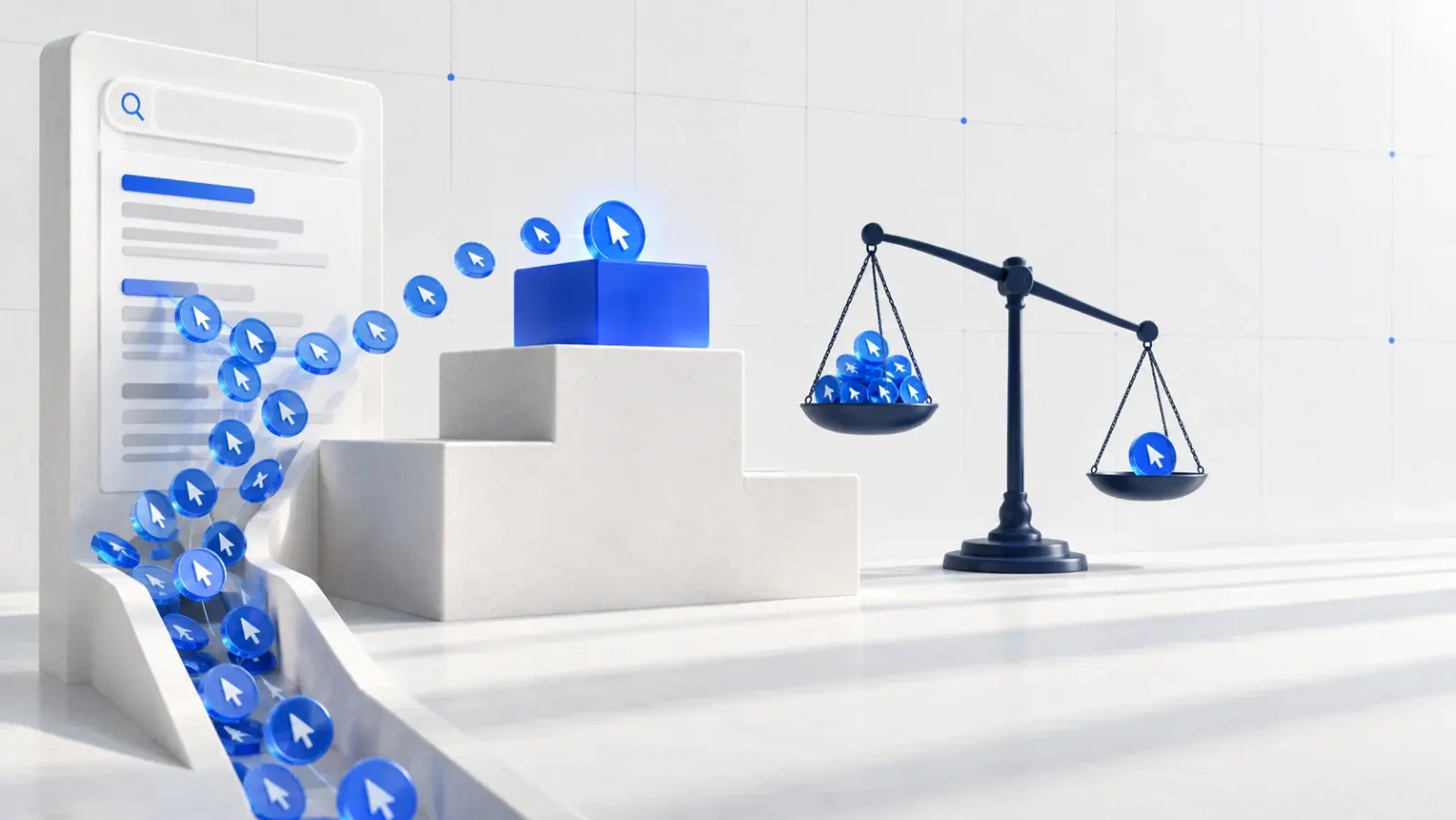
Ranking first on Google still gets you seen, but it no longer brings the clicks it used to. On desktop keywords that showed an AI Overview, Ahrefs found that the top result's click-through rate was 58% below its forecast without one. Seer Interactive tracked 5.47 million queries for 53 brands and saw the same pattern. A controlled experiment with people recruited in March 2026 adds causal evidence: when Google's AI features were removed, people clicked through to websites more.
What the 58% figure actually measures
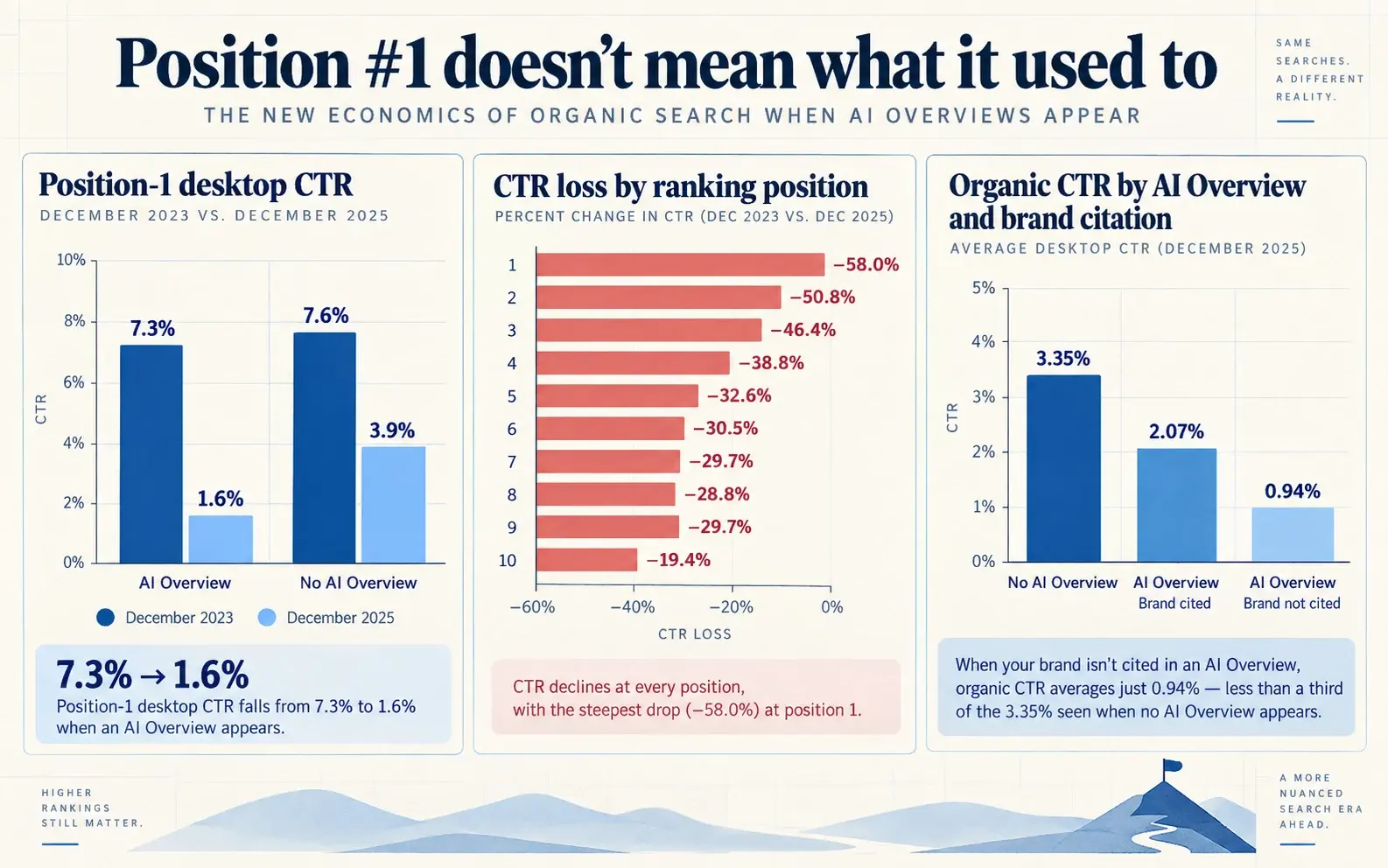
Ahrefs took 300,000 keywords from its database: 150,000 that show an AI Overview and 150,000 informational keywords that don't. It compared each group's combined desktop click-through rate (CTR) from Search Console in December 2023 and December 2025.
| Keyword group | December 2023 | December 2025 |
|---|---|---|
| With an AI Overview | 7.3% | 1.6% |
| Informational, no AI Overview | 7.6% | 3.9% |
Ahrefs used the second group to forecast where the first would have landed without AI Overviews: about 3.7%. The actual figure, 1.6%, is 58% below that. Put another way, for every 100 clicks a top page on those keywords could have expected, it now gets about 42.
Two caveats keep the number honest. First, it compares two groups of keywords, so it's a correlation, not an experiment. Second, Ahrefs' earlier version of the study, from April 2025, put the gap at 34.5%. The figure keeps moving, and it has grown as AI Overviews have spread.
The second row matters as much as the first. On keywords without an AI Overview, position 1 also lost about half its CTR over the same two years. AI Overviews are the biggest force on clicks, but not the only one.
The loss shrinks further down the page
The same study measured the gap at every position on page one. It is largest at the top, where most of the clicks were.
| Position | CTR against forecast |
|---|---|
| 1 | −58.0% |
| 2 | −50.8% |
| 3 | −46.4% |
| 4 | −38.8% |
| 5 | −32.6% |
| 6 | −30.5% |
| 7 | −29.7% |
| 8 | −28.8% |
| 9 | −29.7% |
| 10 | −19.4% |
Seer's data: the losses, a partial recovery and the citation premium
Seer Interactive's 2026 update follows 53 brands from January 2025 to February 2026, using their Search Console and paid search data. That's 5.47 million queries and 2.43 billion organic impressions. On queries with an AI Overview, organic CTR hit a low of 1.31% in December 2025, against 3.16% on queries without one. By February 2026 it had climbed back to 2.36%, still well below the 3.82% on queries without one.
The more useful finding is who gets the clicks that remain. On informational queries across 2025, brands cited inside the AI Overview earned 2.07% organic CTR. Brands that weren't cited earned 0.94%. Queries with no AI Overview gave 3.35%. So being cited earned about 120% more clicks per impression than not being cited, but still about 38% fewer than facing no AI Overview at all.
| Situation | Organic CTR | Clicks per million impressions |
|---|---|---|
| No AI Overview | 3.35% | About 33,500 |
| AI Overview, your brand cited | 2.07% | About 20,700 |
| AI Overview, your brand not cited | 0.94% | About 9,400 |
Seer is careful about what this can show. It can't prove cause, because stronger brands are also more likely to be cited. And one account made up 47% of the not-cited impressions at a 0.20% CTR, which pulls that group's average down.
The experiment that shows cause, not just correlation
Correlations leave room for other explanations. A preregistered field experiment, reported in an August 2026 preprint, adds causal evidence. The study enrolled 1,444 US adults. Of those, 1,100 searched at least once during the seven-day test and made up the behavioural analysis sample. After three baseline days, a browser extension put each person into one of three groups for seven days. One group used Google as normal. One had AI Overviews hidden, and AI Mode returned regular search results. In the last group, every search went to AI Mode.
- Sending every search to AI Mode cut click-through to other websites by 18.8 percentage points, compared with normal Google, with a 95% confidence interval of 15.3 to 22.2 points.
- Removing AI Overviews and AI Mode raised click-through by 8.8 points, with a 95% confidence interval of 2.3 to 15.3 points.
- AI Mode also lowered trust in the results by 0.34 points on a seven-point scale, and cut satisfaction by 0.73 standard deviations. Removing the AI features made no significant difference to trust.
The limits matter. The people in the study were younger, more educated and more left-leaning than the US as a whole. The AI Mode group had to use it for every search, which almost nobody does today: before the test, AI Mode handled just 0.6% of their searches. Google also changed its results page code during the study, so in the no-AI group, only 51.1% of AI Overviews were hidden overall. It is a one-week, US-only result, but it provides causal evidence and points the same way as the other data.
Even Wikipedia lost search traffic
A second study used a natural experiment. AI Overviews became part of the default US search experience in May 2024, so Mehrzad Khosravi and Hema Yoganarasimhan compared search visits to English Wikipedia articles with visits to the same articles in German and French. From May to December 2024, having AI Overviews on by default cut English Wikipedia's search traffic by 5.45% compared with the German version and 4.82% compared with the French version.
That's far smaller than Ahrefs' figure, and it measures something else. It counts every English search visit to Wikipedia in the first eight months, not position-1 CTR on keywords known to show an AI Overview. The direction is what matters. The study's design, called difference-in-differences, rules out most of the seasonal and platform effects that cloud year-on-year comparisons.
B2B sites: impressions up, clicks down
Grey Matter's study, The Great Declick, compares April to June 2025 with April to June 2026, using Search Console data from 18 B2B companies. To rule out ranking changes, it keeps only queries whose position moved by two places or fewer: 1,672 of them.
| Query type | Q2 2025 | Q2 2026 | Change |
|---|---|---|---|
| Informational | 0.90% | 0.56% | −38% |
| Commercial | 1.63% | 1.30% | −20% |
| Branded | 10.07% | 9.87% | −2% |
Among page-one informational queries with at least 100 impressions, the share earning less than 1% CTR rose from 53% to 82%. Informational impressions rose 7% while clicks fell 39%. That's the new economics in one line: more visibility, fewer visits. Grey Matter notes that AI Overviews were live in both periods, so this measures their spread, not a clean before and after.
Branded searches held up because those people already know where they're going. They're one step from typing your address instead of searching, the split behind what "Search Google or type a URL" means for your site.
Estimate what AI Overviews cost you
The calculator applies either study to your own numbers. Enter your monthly impressions and the CTR you get on searches without an AI Overview, then set how many of those searches show one. Search Console gives you impressions and CTR, and a rank tracker that records results-page features tells you which of your keywords show an AI Overview.
Calculator
Your clicks with and without AI Overviews
- Clicks lost each month
- 11329% of your clicks
- Clicks with AI Overviews
- 277
- Lost to AI Overviews
- 113
- Clicks without AI Overviews
- 390
Applies a 58% lower CTR to the share of searches with an AI Overview. That's Ahrefs' figure for position 1: 300,000 desktop keywords, December 2023 against December 2025. Averages from other sites, not a forecast for yours.
Try the Seer setting and switch between cited and not cited. On the same impressions, being cited more than doubles the clicks. For many pages, that gap is worth more than the next ranking position.
What this changes about how you measure SEO
- Report rankings and impressions as visibility, and clicks as a separate outcome. A page can hold position 1 and lose half its traffic with nothing wrong on the page.
- Track whether you're cited, not just where you rank. Since 31 August 2026, every site can see Search Console's Search generative AI performance report. It counts impressions in AI Overviews and AI Mode, but not clicks. Measuring citations across assistants covers the rest.
- Value each click more. Google says clicks from results pages with AI Overviews are higher quality: people spend longer on the site. It hasn't published the data behind that, so check it against your own analytics first.
- Shift effort toward searches that still need your site: pricing, sign-ups, tools, bookings. An AI Overview can sum up a comparison, but it can't complete the purchase. How AI Overviews are rewriting commercial SEO goes deeper.
- Earn the citation. Seer's data shows a large gap between cited and uncited brands. What makes a web page citable covers the work on the page, with a scorecard.
None of it works if the crawlers behind AI answers can't reach your pages. Our AI visibility checks look at that first. Once they can, the structure of a page an assistant will quote decides the rest.
Earning the citation is not a one-off fix. It takes a steady supply of pages that answer first, back their claims with sources and link to the pages that sell. Every week you don't publish one, the click goes to a competitor who did. AutomatedSEO keeps that supply coming. It checks what already ranks for the searches your buyers make, then writes and publishes 30 articles a month in your voice, each one linked to your money pages.
Win back the clicks your rankings should be earning
AutomatedSEO researches, writes and publishes 30 articles a month to your connected CMS.
3-day trial · Cancel any time
Sources
Checked on 27 September 2026.
- Ahrefs: AI Overviews Reduce Clicks by 58%
- Seer Interactive: AIO Impact on Google CTR, 2026 Update
- Wang et al., AI in Search Reduces Publisher Referrals Without Improving User Experience: Experimental Evidence (2026)
- Khosravi and Yoganarasimhan, Impact of AI Search Summaries on Website Traffic: Evidence from Google AI Overviews and Wikipedia (2026)
- Grey Matter: The Great Declick
- Ahrefs: Real organic CTR benchmarks
- Google Search Central: AI features and your website
- Google Search Central Blog: Introducing Search Generative AI performance reports in Search Console
- Search Console Help: Generative AI performance report
Written by
Founder and SEO specialist
Mielad Niekzad is the founder of AutomatedSEO and an SEO specialist.
More from Mielad Niekzad