
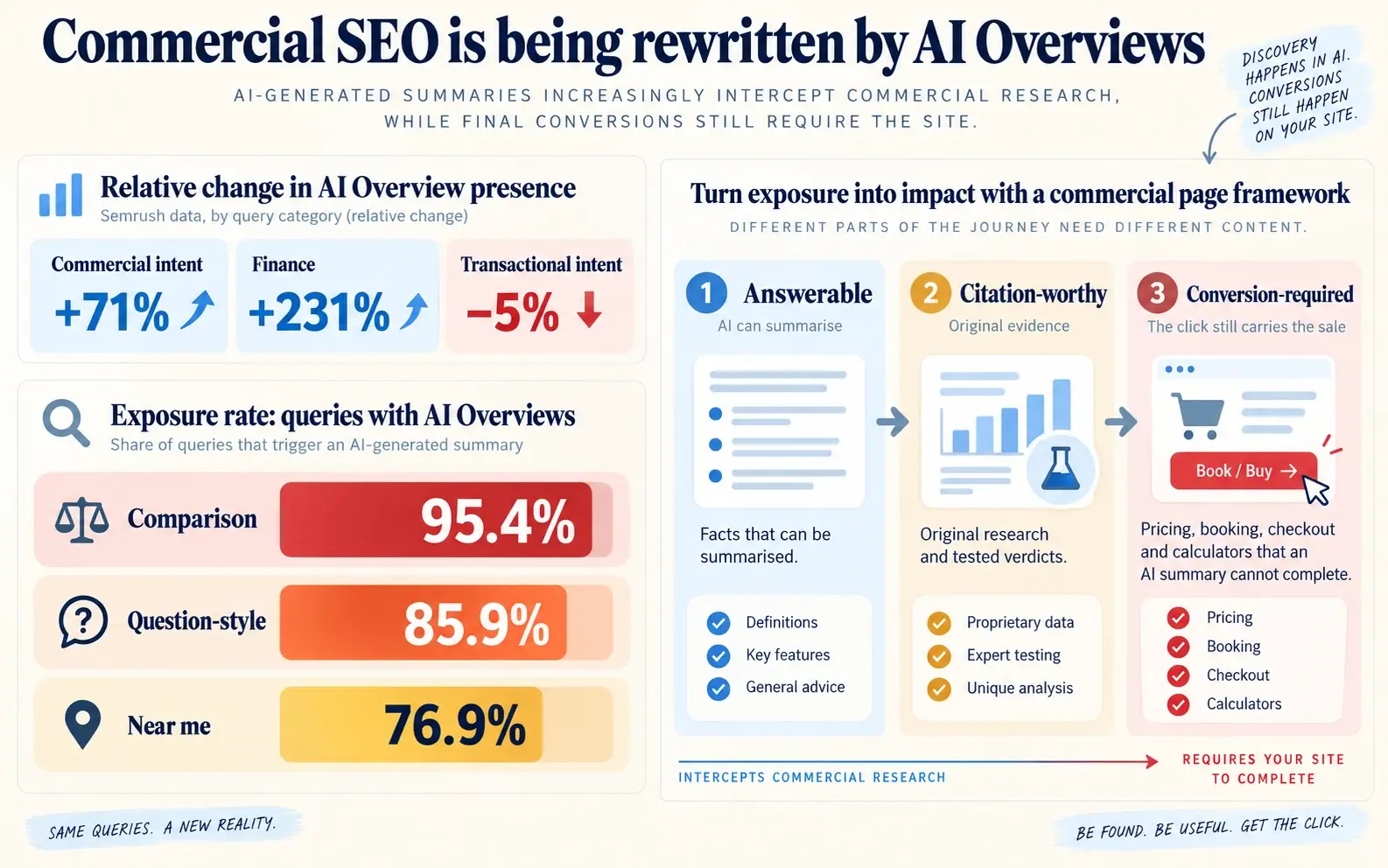
AI Overviews started with questions. Now they're moving onto the searches that make money. Semrush tracked more than 600,000 US desktop keywords from November 2025 to April 2026. The share of commercial-intent results showing an AI Overview grew by 71%. In finance it grew by 231%. The searches people make while deciding what to buy are increasingly answered before anyone reaches your comparison page, service page or product.
What Semrush found
The study split keywords by industry, search intent and cost per click across ten industries. The growth figures are relative: Semrush reports how much the share of AI Overviews rose, not where it started, so a 231% rise may start from a small base.
| Segment | Change |
|---|---|
| Commercial intent, all industries | +71% |
| Commercial intent, finance | +231% |
| Commercial intent, computers and electronics | +108% |
| Commercial intent, games | +77% |
| Transactional intent, all industries | −5% |
Transactional searches, where someone is ready to buy, moved the other way overall. The share of those searches with an AI Overview fell 5%. The exceptions were computers and electronics (up 80%) and news (up 46%). The pressure is on the research stage, the comparisons and "best X for Y" searches, more than on the checkout.
Paid search sits in the same space. Semrush found that the share of results showing both Google Ads and an AI Overview roughly doubled over a year, and AI Overviews cluster on expensive keywords. In finance, keywords with an AI Overview averaged $4.84 cost per click, against $2.14 without one. In jobs and education it was $5.02 against $1.51, and more than 60% of that industry's highest-CPC keywords showed an AI Overview.
Comparison searches are the most exposed
Seer Interactive's 2026 data, from 53 brands' Search Console and paid search accounts, shows where the exposure is highest. An AI Overview appeared on 95.4% of comparison queries, 85.9% of question-style queries and 76.9% of "near me" queries. The comparison sample is small, at 79,436 impressions, so read it as a strong signal, not a precise rate.
In Seer's group, commercial queries as a whole are still less exposed than informational ones. Only 8% showed an AI Overview, against 36% of informational queries and 5% of transactional ones. The exposure is concentrated in certain kinds of search, and comparisons are the most exposed of all.
Where AI Overviews do appear, uncited brands lose the most clicks. On transactional queries with an AI Overview, organic CTR for brands that weren't cited fell from 4.17% to 2.15% during 2025. Seer also found commercial CTR falling on queries without AI Overviews, so other changes to the results page are squeezing commercial clicks too. Grey Matter's data agrees. Across 18 B2B companies, commercial CTR on position-stable queries fell 20% between Q2 2025 and Q2 2026, and the drop showed up in 12 of the 18 accounts.
Comparison pages
A comparison page that restates public feature lists is exactly what an AI Overview can build from other sources. What it can't build is what you tested: your own benchmarks, prices checked on a stated date, screenshots and a clear pick for each use case. Put the verdict in the first paragraph. Put the comparison in a table with one fact per cell. Our comparison of the best AI tools for SEO is built that way.
Service pages
Local service searches are heavily exposed: 76.9% of "near me" queries in Seer's data showed an AI Overview. Google's guide says a complete Business Profile helps services appear in AI responses and regular search results. Then make the service page answer what an overview can't know: price ranges, availability, service area, turnaround and who actually does the work.
Product content
For products, Google recommends Merchant Center feeds for the same reason: structured product data can appear in AI responses as well as regular results. The page should carry what a feed doesn't: specs checked against the product, original photos, sizing advice and returns. Some stores use AI to write product titles and descriptions or to make images. Google's guidance says those AI-generated titles, descriptions and images must be labelled as AI-generated in Merchant Center.
Paid search
Paid and organic results now compete with the same AI Overview. Seer tracked paid CTR from January 2025 to February 2026. On queries without an AI Overview it went from 25.98% to 21.85%, and on queries with one from 14.64% to 16.21%. Brands cited in the overview held a paid CTR between 13.99% and 17.95% all year, about four points above uncited brands.
Semrush points out a practical gap: Google Ads doesn't report which paid queries trigger an AI Overview. Until it does, check your highest-spend keywords in an SEO tool that records results-page features, and read organic citations and paid results side by side.
A framework: answerable, citation-worthy, conversion-required
Sort every commercial page by what an AI Overview can do with it. The three groups need different work and different measures.
| Answerable | Citation-worthy | Conversion-required | |
|---|---|---|---|
| What it is | Facts an AI Overview can state in a sentence or two: definitions, specs, public feature lists | Something only you have: original data, tested verdicts, expert judgement, current prices | Pages where the searcher must act on your site: pricing, quotes, bookings, sign-ups, checkout, tools |
| Commercial examples | "Do I need a CRM?", "monthly vs annual billing", a spec sheet copied from the manufacturer | Your benchmark of five CRMs, a cost survey, a comparison with a pick for each use case | A pricing page, a quote calculator, a product page with stock and delivery, a free trial |
| What AI Overviews do to it | Answer it on the results page. Expect clicks to fall whatever you do | Cite it as a source. Cited brands keep far more of the remaining clicks | AI Overviews can summarise it, but can't complete it. The click still carries the sale |
| What to do | Keep it short and accurate, merge thin variants, link it to the pages below | Invest here: first-party numbers, a named author, dated facts, the answer first | Make it fast and specific: price, availability, proof, one next step; keep it indexable and in your feeds |
| Measure it by | Impressions, including AI feature impressions | Citations, and clicks on the queries where you're cited | Conversions and revenue per visit |
Three questions sort a page:
- Can the core answer be given in one or two sentences from public information? Then it's answerable.
- Does it contain something an overview would have to credit you for, like your data, test, price or verdict? Then it's citation-worthy.
- Does the searcher's goal end in an action only your site can complete? Then it's conversion-required, whatever else it is.
Most commercial sites have too many answerable pages and too few citation-worthy ones. The usual fix is to merge thin answerable pages into one citation-worthy guide, then link it to the conversion page it supports. That's the pattern in internal linking that moves money pages.
Where to start
- Pull your top 50 commercial keywords by revenue or ad spend. Note which ones show an AI Overview.
- Sort the page behind each keyword into the three groups.
- For each answerable page on an exposed keyword, decide: upgrade it to citation-worthy, or merge it.
- Check that the conversion pages are indexable, quick to load, and in your product feed or Business Profile.
- Track citations alongside rankings. Search Console's generative AI performance report shows impressions in AI Overviews and AI Mode for every site.
For what this shift does to clicks overall, see why position 1 doesn't mean what it used to, which includes a calculator for your own numbers. The page-level details of getting cited are in what makes a web page citable by ChatGPT and Google AI. When you plan new pages, choose keywords you can win with the AI Overview in mind.
Sorting the pages takes an afternoon. Filling the citation-worthy column is the long job: one guide after another, each with the answer first, its sources linked and a path to the page where the buyer converts. Until those guides exist, the overview cites whoever wrote them first. Our SEO article writer does that job. It checks what ranks for each commercial search, then drafts 30 articles a month from your own pages and sources. Each draft waits in review for the prices and verdicts only you can add, and links to the money page it supports.
Be the brand AI Overviews cite when buyers compare
AutomatedSEO researches, writes and publishes 30 articles a month to your connected CMS.
3-day trial · Cancel any time
Sources
Checked on 28 September 2026.
- Semrush: AI Overviews are expanding across commercial search
- Seer Interactive: AIO Impact on Google CTR, 2026 Update
- Grey Matter: The Great Declick
- Google Search Central: AI features and your website
- Google Search Central: Optimizing your website for generative AI features on Google Search
- Google Search Central: Google Search's guidance on using generative AI content
- Google Search Central Blog: Introducing Search Generative AI performance reports in Search Console
Written by
Founder and SEO specialist
Mielad Niekzad is the founder of AutomatedSEO and an SEO specialist.
More from Mielad Niekzad